







































Skip to content
Illustration for the article “Choosing the right ad formats for your traffic”

Choosing the right ad formats for your traffic

Ad formats shape not only how ads are displayed but also how audiences interact with the content. That is why choosing the right format matters for both user experience and revenue.

Feb 12, 2026

This article explains how publishers can select ad formats according to traffic type, content, and audience to achieve better results.

Ad formats overview

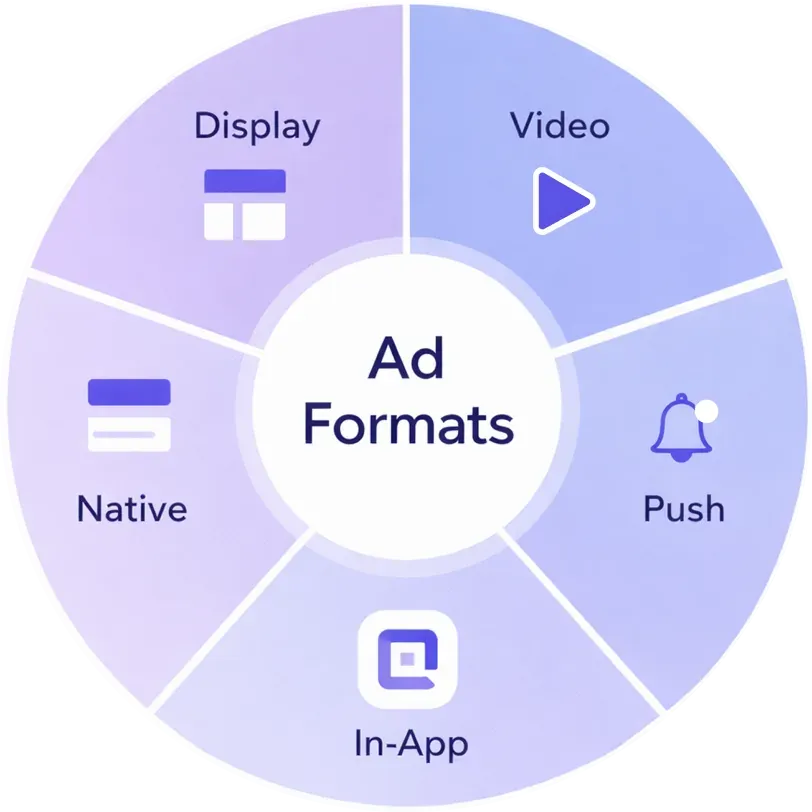
Ad formats shape how content and ads coexist on a page.

Ad formats overview

Display banners provide broad visibility and consistent revenue, while native ads blend with editorial material, supporting better user experience. Video ads drive high engagement and strong CPMs, whereas in-app formats target mobile audiences effectively. Push notifications reach users directly but demand careful timing to avoid disrupting UX.

Understanding traffic types

Where visitors come from

Traffic, or simply the flow of visitors, comes from different sources, and each behaves differently on a publisher's site. Organic traffic arrives from search engines and usually engages deeply with content. Direct traffic consists of returning visitors familiar with the site.

Referral and social traffic can be fast-scrolling, brief, or sporadic. Paid traffic brings targeted users but often has shorter attention spans. Therefore, the selection of ad formats should align with the traffic type.

Criteria for choosing the right formats

To select formats that deliver consistent revenue without disrupting user experience, publishers should evaluate several important factors. Among such are:

  1. 01

    Revenue model

    Some formats pay per impression (CPM), per click (CPC), per action (CPA), or per view (CPV). For predictable earnings, it is essential to match the revenue model to the traffic type and engagement patterns.

  2. 02

    Production and maintenance costs

    Formats like video or interactive ads typically require higher creative investment and ongoing updates, while static banners and native ads are cheaper to produce.

  3. 03

    Traffic engagement and behavior

    Long-session traffic performs well with immersive formats (native, video), while fast-scrolling or mobile users respond better to high-visibility, quick-impact formats (display banners, interstitials).

  4. 04

    Scalability and reach

    Broader campaigns with high impressions can increase revenue but may dilute engagement. Targeted campaigns often provide more efficient results per user.

  5. 05

    User experience impact

    Heavy or intrusive formats may generate short-term revenue but risk increasing bounce rates. Publishers must balance revenue with overall site usability.

  6. 06

    Technical compatibility

    Some formats may not display properly across all devices, screen sizes, or platforms, so it is necessary to ensure proper rendering.

  7. 07

    Ad fatigue and frequency

    Repeated exposure to the same format can reduce effectiveness. Rotating formats or using multiple types may be helpful for sustained performance.

Placement and layout considerations

Where an ad appears on a page influences how visible it is to visitors. Above-the-fold positions, sidebars, and inline placements each have different engagement patterns depending on content type and screen size. Publishers should analyze page structure to ensure that ads complement rather than distract from the reading experience.

Layout decisions also affect how multiple ads work together. Crowding a page with too many formats can reduce overall performance, while thoughtful spacing preserves clarity and flow.

Ad Placement & Layout

Devices
Devices
Layout
Layout
Engagement
Engagement

Testing and optimization

Testing placement variations across devices allows publishers to identify setups that perform best for their audience. Common methods include:

  • A/B testing — Comparing two placement or format variations to see which performs better.
  • Multivariate testing — Evaluating multiple elements simultaneously, such as size, position, and format.
  • Performance monitoring — Tracking metrics like CTR, viewability, and engagement over time.
  • Heatmaps and scroll maps — Visualizing where users look and scroll to optimize ad positioning.
  • User segmentation analysis — Testing formats across different audience segments (device type, location, behavior).
  • Frequency capping tests — Adjusting how often users see the same ad to prevent fatigue.
  • Page speed impact analysis — Ensuring ad placements do not slow loading or harm engagement.

Regular monitoring and refinements ensure formats remain effective and balanced with site design.

Summary

Selecting ad formats strategically determines how well a site generates revenue, retains users, and engages its audience. Publishers who align formats with traffic type, layout, and behavior, while continuously testing and optimizing, can achieve viable performance and continued growth.